Improve diagnostic access without ignoring staffing, equipment, utilization and cash.
Graduate venture concept · CareBridge
Mobile Diagnostics Venture
A healthcare service-design project that tested a mobile cardiac-diagnostics concept through operating assumptions, break-even math, cash flow and a gated rollout — not just a pitch narrative.
Project contextGraduate venture concept · Team of 4 · Financial figures based on the final July 2026 model.
Decision summary
A 36-month operating and financial model tested throughput, clinic-day economics, break-even timing and rollout assumptions.
Use staged rollout and funding gates so scale depends on operating and cash performance.
Co-developed the venture and operating model; built and refined the integrated financial model.
The question
Can a clinic-hosted diagnostic service improve access while still surviving the economics of staffing, equipment, utilization and cash?
Operating model
The service moves the testing operation closer to the patient.
01 · The access problem
The concept moves a testing day, not a patient journey.
CareBridge uses a clinic-hosted model for cardiac diagnostics: the clinic provides room and patient access; CareBridge coordinates the mobile testing operation; and a cardiology or diagnostic partner handles medical interpretation and the payment pathway.
02 · The economics
The final model made utilization the central financial driver.
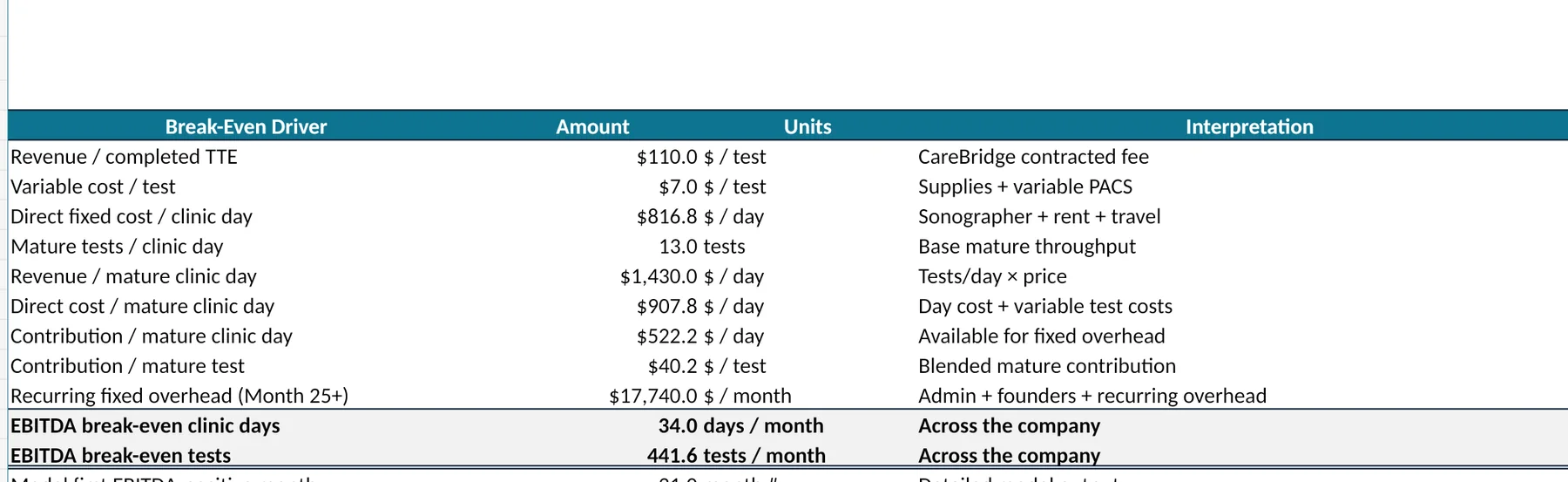
The final spreadsheet uses C$110 of revenue per completed test and a mature throughput assumption of 13 tests per clinic day. At that level, a mature clinic day produces C$1,430 of revenue and C$522.20 of contribution before recurring overhead.
03 · What could break it
Operational risk was more important than technology novelty.
The model depends on enough booked demand, reliable technologist and equipment coverage, partner reporting, quality controls and a clinic-day cadence that can support fixed costs. That is why the rollout is staged rather than assuming all sites operate at full capacity from day one.
04 · What the model showed
Scale became conditional on cash and operating gates.
The 36-month model reaches its first EBITDA-positive month in Month 21 and first net-income-positive month in Month 23. It models four fixed accredited host sites by Month 36, with staged openings rather than a single launch event. The proposed C$400,000 seed investment is split into two tranches so later deployment depends on progress.
Selected work product
Selected project evidence.
What I took from it