Use AI to scale decision support without losing human judgment, governance or accountability.
Dean’s Cup · Team competition strategy project
Optimus Edge
A team case-competition recommendation for a human-governed AI execution model — chosen over a narrow internal productivity tool and a generic standalone AI platform.
Project contextDean’s Cup team competition project · External benchmarks informed the recommendation and are not presented as project outcomes.
Decision summary
The team compared three strategic alternatives and used external benchmarks to test the commercial logic.
Recommend a human-governed four-layer execution model with a five-year transformation roadmap.
Contributed to strategy development, alternative evaluation, governance logic and presentation development.
The question
How can an execution-focused consulting firm use AI to scale decision support without giving up human judgment, governance or accountability?
Governance architecture
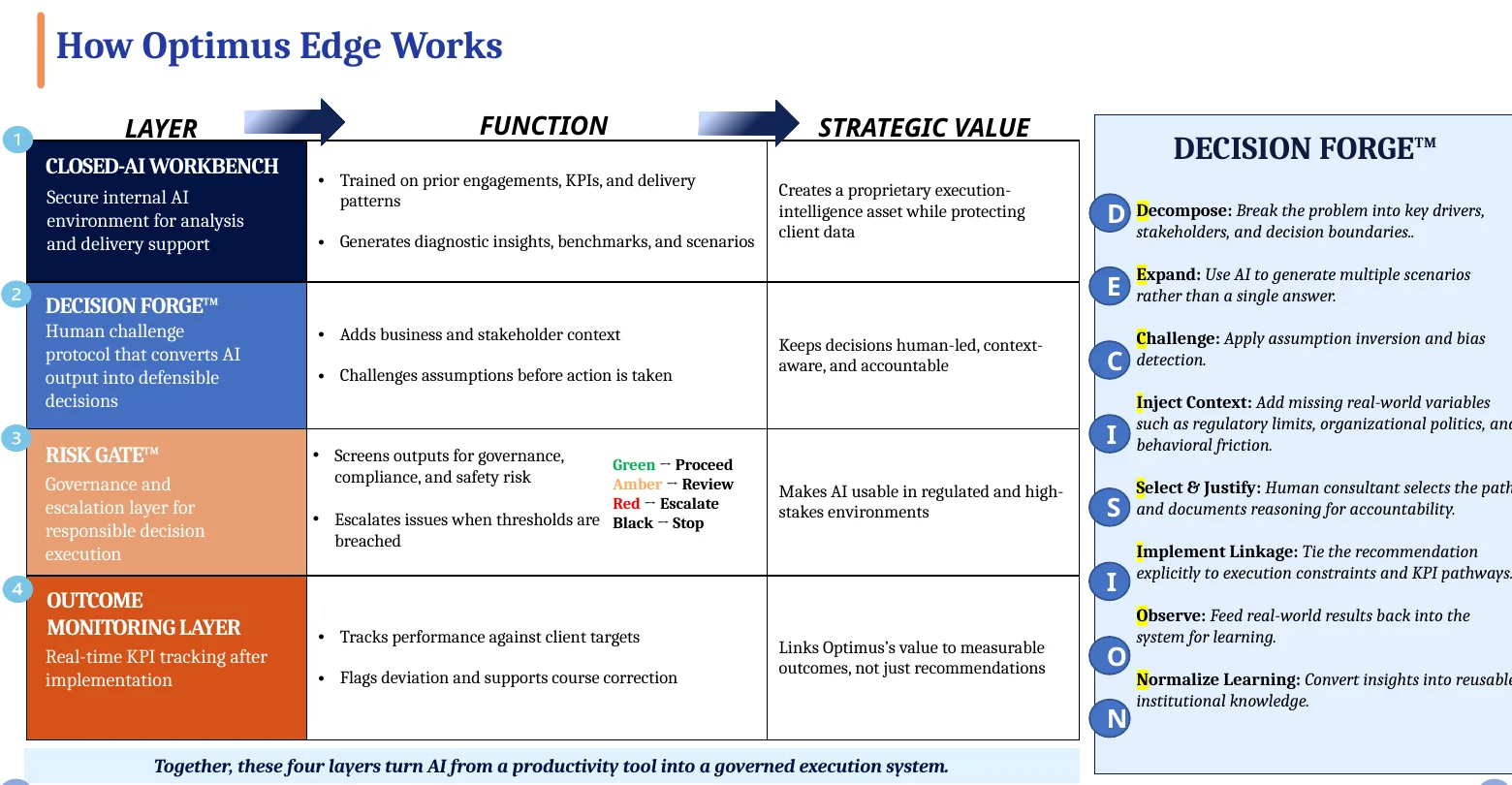
AI speed is separated from human challenge, risk and outcome ownership.
01
Closed-AI WorkbenchSecure analysis
02
Decision ForgeHuman challenge + context
03
Risk GateGovernance + escalation
04
Outcome Monitoring LayerPerformance after implementation
01 · The industry shift
The team did not treat “use AI” as a strategy.
The Dean’s Cup case asked how an execution-focused consulting firm should respond as AI makes analysis faster and more abundant. We compared three strategic options rather than assuming the most technical choice was the best one.
02 · Options considered
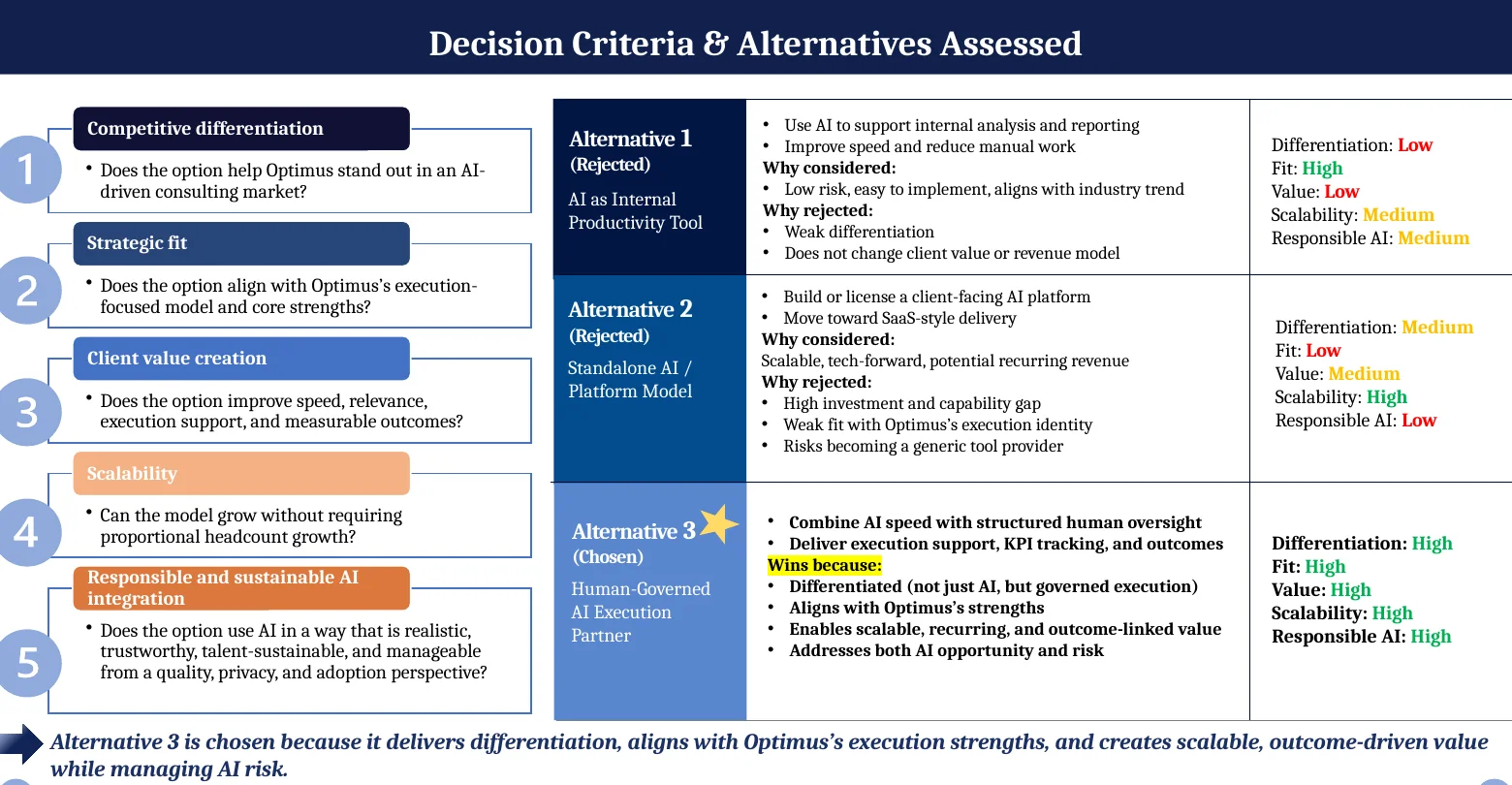
Two simpler paths were rejected.
Alternative 1 used AI mainly as an internal productivity tool: easy to implement, but weakly differentiated. Alternative 2 moved toward a generic standalone platform: scalable in theory, but a poor fit with the firm’s execution identity and capability base. The chosen alternative combined AI speed with structured human oversight.
03 · How the model works
Governance was designed into delivery.
Optimus Edge linked four layers: a Closed-AI Workbench for secure analysis; Decision Forge for human challenge and context; Risk Gate for governance and escalation; and an Outcome Monitoring Layer to track performance after implementation.
04 · Implementation
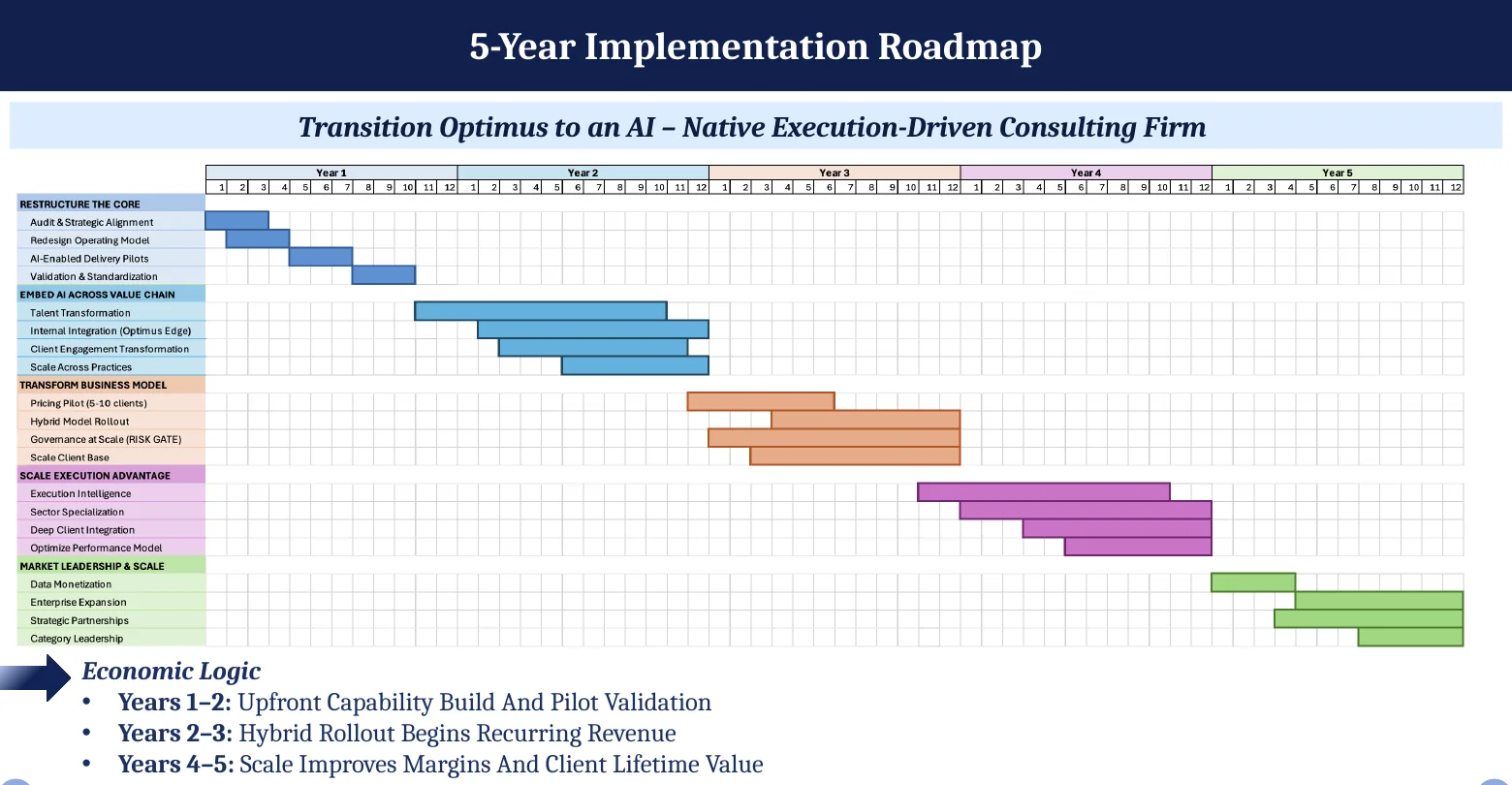
The recommendation was a transformation path, not a software launch.
The final team deck included a five-year implementation roadmap and explicit risks around trust, context, privacy, capability gaps and recurring-fee resistance. Externally sourced productivity benchmarks informed the commercial logic.
Selected work product
Selected project evidence.
What I took from it